Fibre & Fullness
The Quiet Work of Fibre in Shaping Midday Hunger
Eleanor Whitfield·

London, February 2026. The afternoon shift of appetite — that particular restlessness that arrives somewhere between two and four o'clock — is one of the more discussed and least understood rhythms in everyday food observation. Field notes from the Osteva archive, collected across several months and dozens of contributors, suggest that the composition of the midday meal, and specifically its protein content and source, plays a notable role in determining both when this signal arrives and how insistently it announces itself.
Among the three primary macronutrients — carbohydrates, fats, and protein — protein has the most consistently documented relationship with satiety in the published nutrition literature. The mechanism is not simple, and the published research touches on several overlapping pathways: the influence of protein on gut daily balance associated with fullness, the energy required to break down protein relative to other nutrients, and the effect of protein on the pace at which the stomach empties after a meal.
What makes this practically interesting for food observers is not the biochemical detail but the observable consequence: meals with adequate protein — whether from animal or plant sources — tend to be followed by a longer period of comfort and a more gradual return of hunger. This is not a universal rule. It is a pattern, and patterns require individual verification.
Contributors to the Osteva archive who logged afternoon appetite patterns alongside their midday meal compositions showed a consistent pattern: lunches that included a portion of animal protein — fish, poultry, eggs, or dairy — were followed by a notably longer interval before the next reported hunger signal compared with lunches of similar caloric weight built primarily around refined carbohydrates.
Eggs appeared with particular frequency in the positive satiety logs. A lunch of two eggs with a salad of greens, cherry tomatoes, and whole grain bread was one of the most commonly logged meals in the archive — and one of the most frequently noted as producing a calm, stable afternoon appetite. The combination of protein, moderate fat, and fibre from the salad and bread appears to operate as a complement, extending the period of comfort beyond what any single component would achieve alone.
Oily fish — particularly salmon and mackerel — featured prominently in the highest-rated satiety logs. Their protein content, combined with the presence of omega-3 fatty acids, appeared to produce a particularly extended post-meal comfort in contributor records. Those who ate a portion of salmon at lunch consistently reported stable appetite patterns through the mid-afternoon, with hunger arriving, when it did, in a measured rather than urgent form.
"Oily fish at midday. The afternoon passed without incident. A note made, a pattern forming — the kind of observation that takes weeks to trust."
— Contributor log, Osteva Field Notes archive, February 2026
Plant-based protein sources — tofu, tempeh, edamame, lentils, chickpeas, and various beans — present a different profile from animal proteins but are nonetheless well-represented in the archive's positive satiety records. Their advantage, in practical terms, is the combination of protein with dietary fibre, a pairing that produces a dual effect on fullness: the protein acting through the everyday and digestive pathways noted above, and the fibre contributing through the volume and slowed-digestion mechanisms described in the archive's earlier entry on fibre.
Tempeh, a fermented soy product, was consistently noted among plant-based contributors as one of the most satisfying protein sources across the afternoon. Its protein density — higher than most unprocessed plant foods — combined with its textural density made it a reliable component in lunches designed around extended fullness. Contributor logs showed that tempeh-based lunches typically produced stable appetite patterns for three to four hours, comparable to similar portions of animal protein in the same records.
Chickpeas, lentils, and black beans appeared frequently as the base of salads and warm dishes in the archive's positive satiety entries. Their digestive pace — slower than most animal proteins due to their resistant starch and fibre content — was reflected in the timing of reported hunger signals. Contributor logs showed a characteristically gradual return of appetite after legume-based lunches, with hunger arriving as a gentle signal rather than the more urgent form associated with lower-protein or lower-fibre meals.

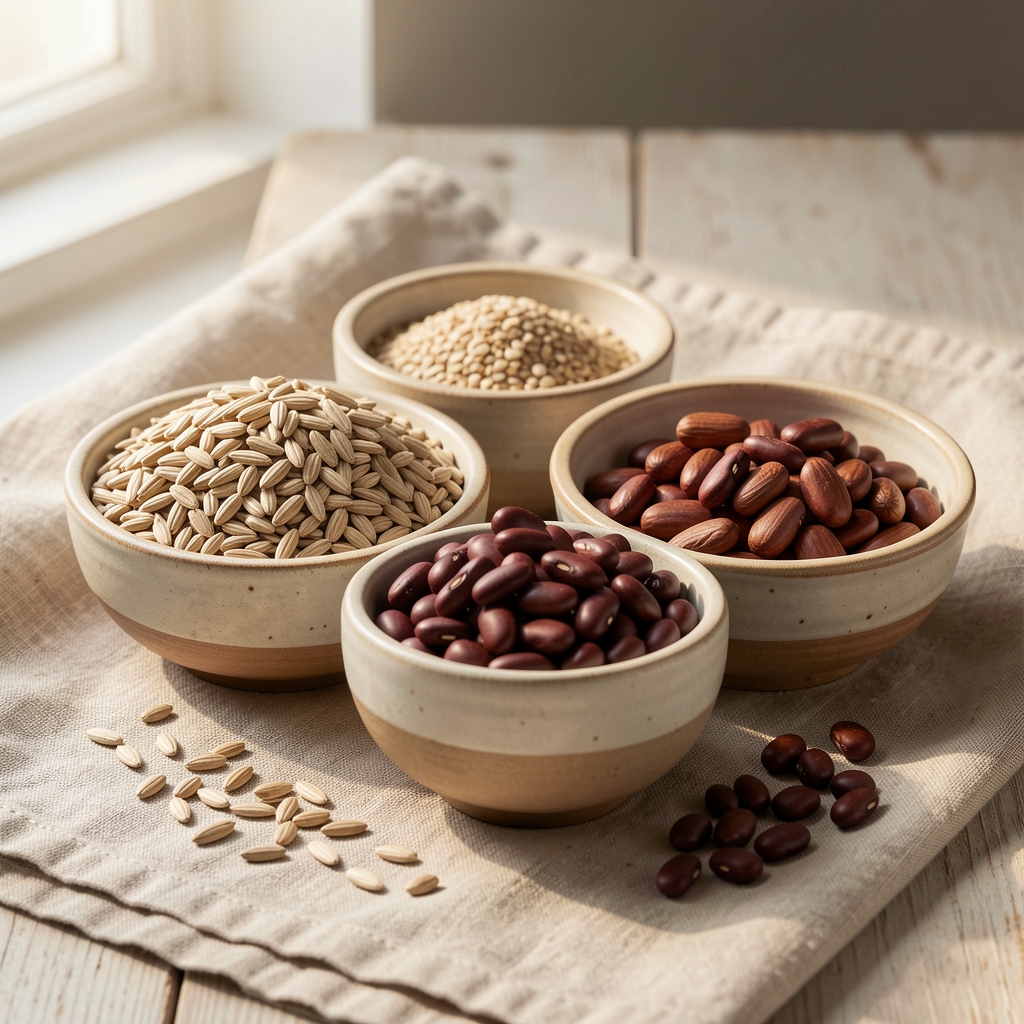
Plant protein at midday — tempeh and legumes, archived February 2026.
One of the more nuanced observations from the archive concerns not just the presence of protein in a meal but its concentration relative to the meal's total volume. A large plate of salad with a modest scattering of protein — a spoonful of chickpeas, two strips of chicken — produced less durable satiety than a smaller, more protein-concentrated meal. This suggests that portion awareness matters not only at the level of total intake but at the level of composition: the ratio of protein to other elements in the meal.
Contributors who tracked protein portions explicitly — noting the weight or estimated volume of protein in their midday meals — showed more consistent correlation between protein intake and afternoon satiety than those who simply noted "salad with chicken" or "bowl with beans". The precision of observation, it seems, produces more reliable patterns. This is a common finding in food journalling research and is reflected in the Osteva archive's own methodology guidelines.
The most consistently positive satiety records in the Osteva archive belong to meals that combined protein with both dietary fibre and moderate fat. The combination appears to extend the period of comfort beyond what any individual component would produce on its own. A lunch of salmon with a quinoa salad, roasted vegetables, and a drizzle of olive oil hit all three elements simultaneously — and appeared in the archive's highest-satiety-rating entries with notable frequency.
Fat, in this context, slows gastric emptying — the rate at which the stomach passes its contents to the small intestine. Combined with the fibre-driven slowing of digestion and the protein-driven everyday effects, the result is a meal that occupies the digestive system for an extended period, producing a gradual and sustained sense of fullness that carries contributors comfortably through to the late afternoon.
This is, again, a pattern rather than a rule. Individual variation remains the dominant factor in any food observation exercise. What the archive offers is not a guideline but a documented pattern — one drawn from the lived experience of dozens of food observers logging their meals and their hunger in real time, over weeks, in the ordinary circumstances of working life in London. That pattern, for what it is worth, points consistently toward the midday meal's protein content as one of the more reliable predictors of a calm and measured afternoon appetite.
Articles published on Osteva Field Notes are editorial in nature and reflect the writers' observations on everyday food choices, satiety patterns, and appetite rhythm. The content is not intended as professional advice, nor as guidance for the management of any specific condition. Readers with specific concerns about their daily routines are encouraged to speak with a qualified wellness professional.

Tobias Marsden is a London-based food writer whose work focuses on the practical intersection of nutrition research and everyday eating habits. He has contributed food observation pieces to several independent publications and maintains a personal log of his midday meal patterns, from which several entries in this article are drawn.
More from the archive →